
Do you assume that putting a board in an aluminium case shields it?
In reality, a metal case or a shielded cable does nothing unless it is connected to GND. Worse, a floating shield can even act as an antenna that collects noise. This article explains, from the equivalent circuit, why shielding works.
Three Kinds of Shielding
Noise that travels through the air takes three routes, and each calls for a different kind of shield.
- Electrostatic shielding: blocks electrostatic induction (through stray capacitance). Uses an electrical conductor
- Magnetic shielding: blocks electromagnetic induction (flux linkage). A magnetic material at low frequencies, a conductor at high frequencies
- Electromagnetic shielding: blocks electromagnetic waves (the far field). Uses an electrical conductor
The three are separate phenomena, but a real metal case takes on all of them at once. We start below with the most fundamental case, electrostatic shielding.
Electrostatic Shielding — Why It Has to Be Tied to GND
Electrostatic induction is noise transferred through stray capacitance. If a stray capacitance C1 exists between noise source A and victim circuit B, a voltage change at A is passed through it to B.
What happens when a shield (a conducting plate) is inserted between A and B? Let us look at the equivalent circuit.
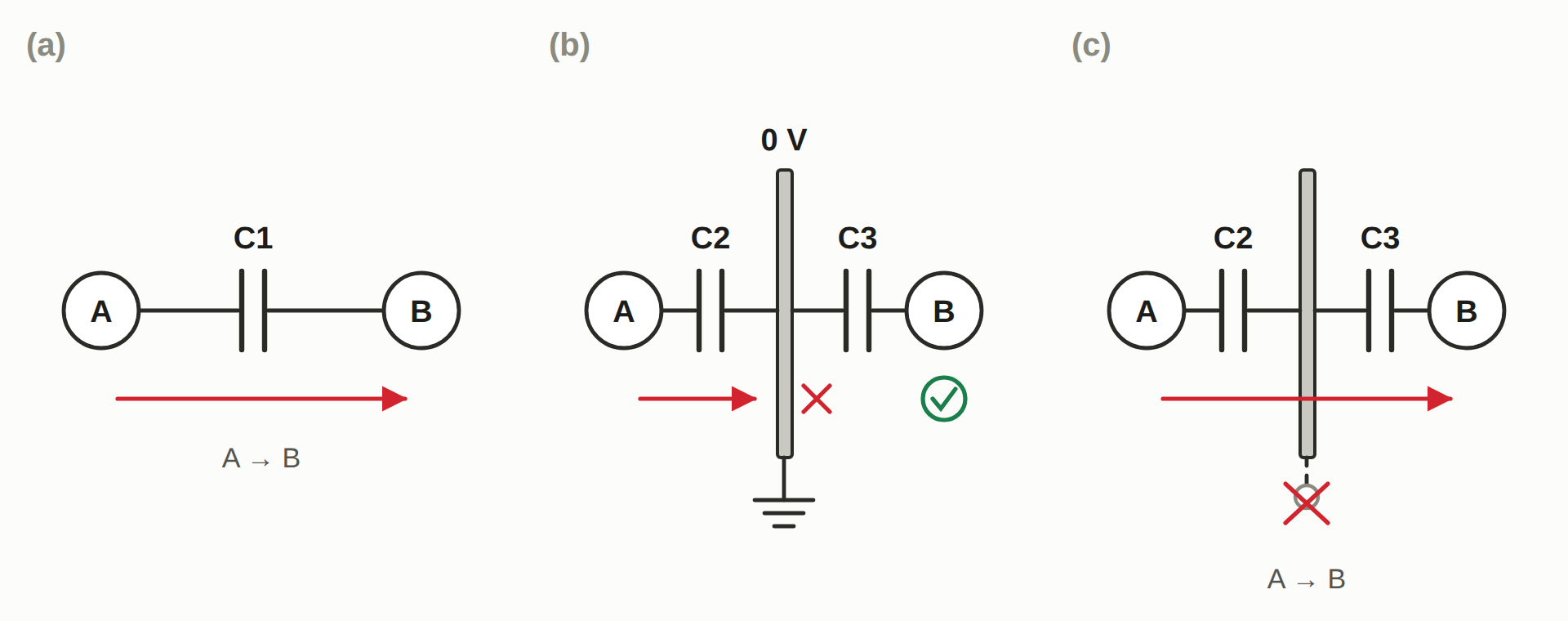
With the shield tied to GND: noise from A reaches the shield through C2, but because the shield is connected to GND its potential is held at zero. If the shield potential is zero, no noise is passed on to B through C3.
With the shield floating (not connected to GND): noise from A shifts the shield potential through C2 and then travels on to B through C3. The shield has become the mid-point of a capacitive divider that relays the noise — the shielding effect is zero, and things can even get worse.
This is exactly why a shield “only works once it is tied to GND”.
Electromagnetic Shielding — “Reflection” and “Absorption” in Metal
Shielding against electromagnetic waves (high frequencies) works because metal reflects and absorbs them.
Reflection loss
The wave impedance of air is about 377 Ω; that of metal is ≪ 1 Ω. Because of this large impedance mismatch, most of the wave is reflected at the metal surface. This effect alone gives even a thin metal sheet a large shielding effect.
Absorption loss
The part of the wave that does enter the metal drives currents (eddy currents) and turns into heat. The wave decays exponentially as it travels into the metal and becomes negligible at a certain depth — the skin depth. The skin depth shrinks as frequency rises, so at high frequencies even thin metal absorbs enough.
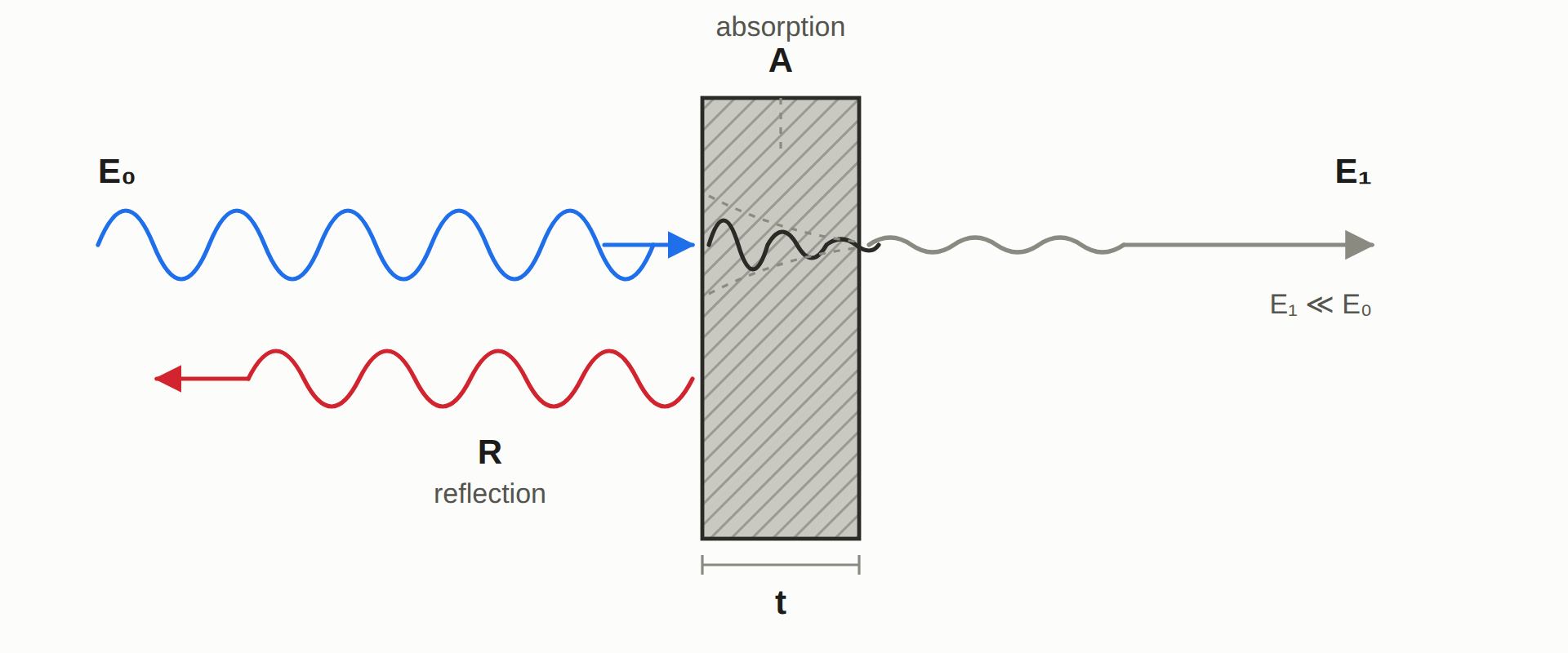
The practical conclusion: even thin metal foil gives ample shielding against high-frequency waves. The awkward case is the low-frequency magnetic field — mains-frequency supply noise and the like — which calls for a high-permeability magnetic material such as permalloy.
“Holes” Ruin a Shield
Electromagnetic shielding only works fully if the enclosure surrounds the circuit without gaps. Real enclosures, however, always have holes and slits: connector cut-outs, ventilation openings, cable entries, panel seams.
What matters is not the “area of the hole” but its length — the long edge. Electromagnetic shielding works because induced current flows in the shield material, and a long, narrow slot cuts that current path. Even with a small area, a long slot does serious damage.
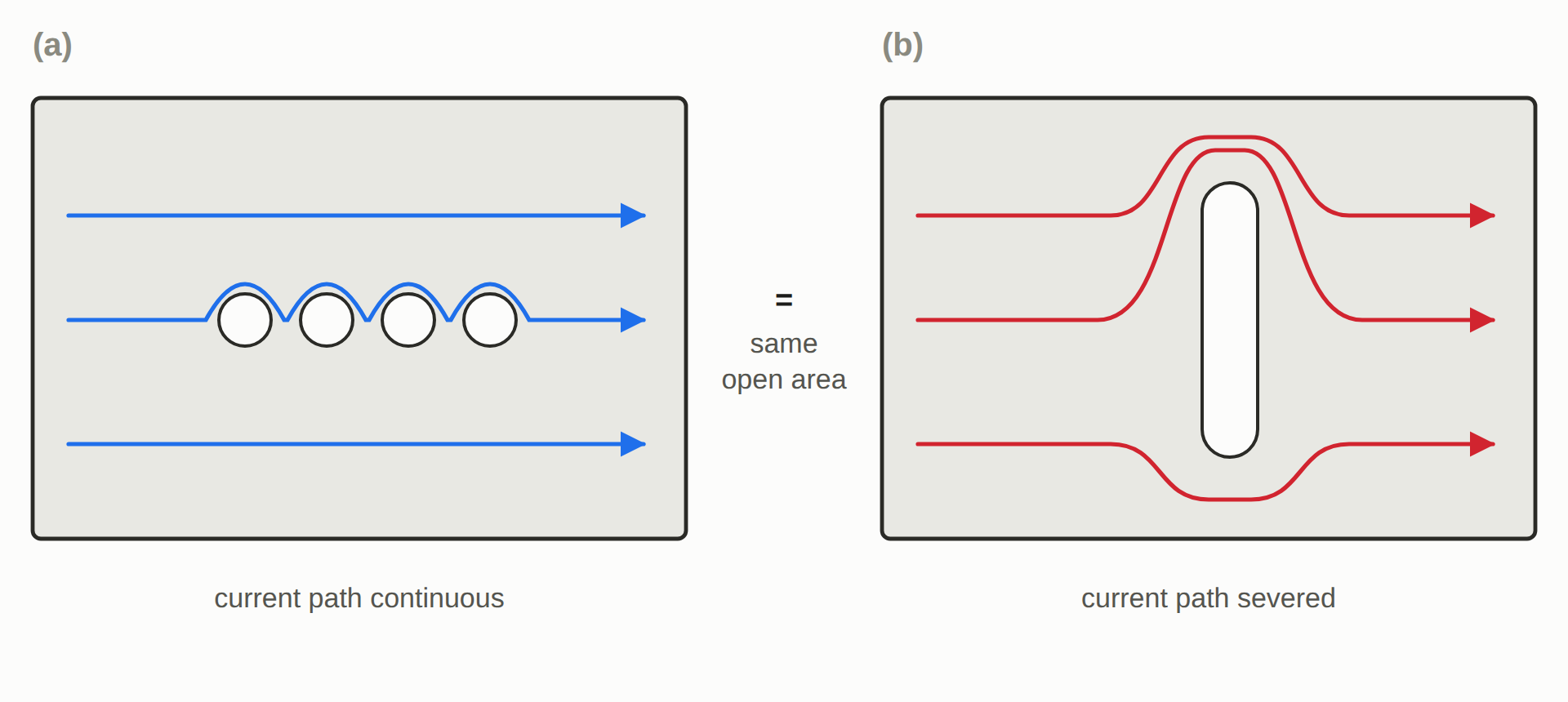
Countermeasures:
- For ventilation, use many small holes rather than one large one (diameter well below the wavelength)
- Bond panel seams electrically and reliably — paint turns a seam into an electrical “hole”
- Use shielded connectors and bond the connector shell to the case GND
Connecting a Cable Shield — One End or Both?
There is a long-running question of whether to connect the shield of a shielded cable at one end only or at both ends.
From the electrostatic point of view, tying the shield to GND is enough, so a single-ended connection is fine. Connecting both ends creates a ground loop, and an external magnetic field linking that loop picks up noise.
Against high-frequency induction, however, the shielding effect comes from current flowing in the shield. Current needs a loop, so connecting both ends is the better choice.
Measurements bear this out: single-ended wins at low frequencies, both-ends wins at high frequencies. Choosing according to the frequencies involved, or bonding both ends and managing the loop by design, is the realistic answer.
The Shielding Effect of a Ground Plane
In board design it is not only the metal case that shields — the ground plane itself acts as a shield.
Bringing a signal trace close to the GND plane makes the trace’s electric field lines terminate on the plane, which reduces crosstalk into neighbouring traces. This is precisely the principle of electrostatic shielding, with the GND plane acting as a conductor at zero potential.
Placing a GND plane on an inner layer of a multilayer board so that it sandwiches the signal layers is the arrangement that maximises this shielding effect.
Summary
- There are three kinds of shielding — electrostatic, magnetic and electromagnetic — and each works on a different principle
- Electrostatic shielding requires a GND connection. Leave the shield floating and it backfires — the equivalent circuit shows exactly why
- Electromagnetic shielding combines reflection and absorption. Even thin metal is effective at high frequencies
- It is the length of an aperture that ruins a shield. Think about the long edge, not the area
- A ground plane also acts as a shield. Routing close to it reduces crosstalk


Comment