Noise Design & EMC

Noise Design & EMC

What Is Common-Mode Noise? Difference from Normal Mode, with Filter Circuits

Common-mode vs normal mode — what's the difference, and why is common mode easy to remove? Learn the definitions (EN = EA−EB, EC = (EA+EB)/2), how a common-mode choke and differential receiver reject it, explained with filter circuits.
Noise Design & EMC

Why Traces Become Antennas: Loop Area and Noise Radiation

Why does a PCB radiate noise? The hidden loop formed by a signal trace and its GND return sets the radiation. Learn why radiation ∝ loop area × current × frequency², and how a ground plane minimizes the loop.
Noise Design & EMC

Single-Point Ground vs. Ground Plane: Which Is Right? (uSimmics)

Single-point ground or a ground plane? Both are correct — but which you use depends on frequency. Learn how common impedance and stray capacitance decide it, compared in uSimmics, plus mixed analog/digital board tips.
Noise Design & EMC

Why Are Decoupling Capacitors Placed Close to the IC? (uSimmics)

Why must a decoupling capacitor sit close to the IC? Learn how wiring inductance (L_wire) and the capacitor's ESL kill high-frequency performance, verified with uSimmics waveforms, plus two-stage placement and layout tips.
Noise Design & EMC

What Is Ground Bounce? Why GND Isn’t 0V, Explained with uSimmics

GND is supposed to be 0V — so why does noise appear? Learn how wiring inductance and V = L×di/dt cause ground bounce, verified with uSimmics simulations, plus three fixes: decoupling caps, a solid ground plane, and reducing di/dt.
Noise Design & EMC

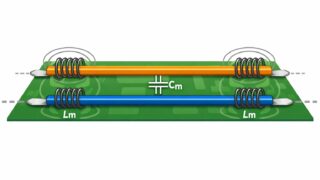
What Is Crosstalk? Understanding Parasitic Coupling in PCB Traces

Crosstalk is an unavoidable effect in high-speed PCB design. This article explains crosstalk at the circuit level, focusing on parasitic capacitive and inductive coupling that do not appear in schematics.
Noise Design & EMC

Why Ferrite Beads Work: Damping Ringing with Loss (uSimmics Waveforms)

Learn why ferrite beads reduce ringing: it’s loss, not “inductance.” Compare ideal L, ideal R, and a real bead (.s2p) in uSimmics.
Noise Design & EMC

What Is Ringing? Understanding Jagged Oscillations with uSimmics

Learn what ringing is in high-speed digital circuits.This article explains LC resonance and damping using a minimal circuit and transient analysis in uSimmics, with clear waveform examples.
Noise Design & EMC

Understanding Signal Reflection in High-Speed Digital Circuits

Learn what signal reflection is in high-speed digital circuits.This beginner-friendly guide explains impedance mismatch, transmission lines, and waveform steps using a simple uSimmics simulation.
Noise Design & EMC

Noise Mitigation Basics with uSimmics: Source → Path → Victim

Learn a simple noise/EMC framework: Source → Path → Victim. See how parasitics (L/C/R) change waveforms in uSimmics, including ground bounce and crosstalk. Understand what decoupling caps, ferrite beads, and solid ground planes really do.