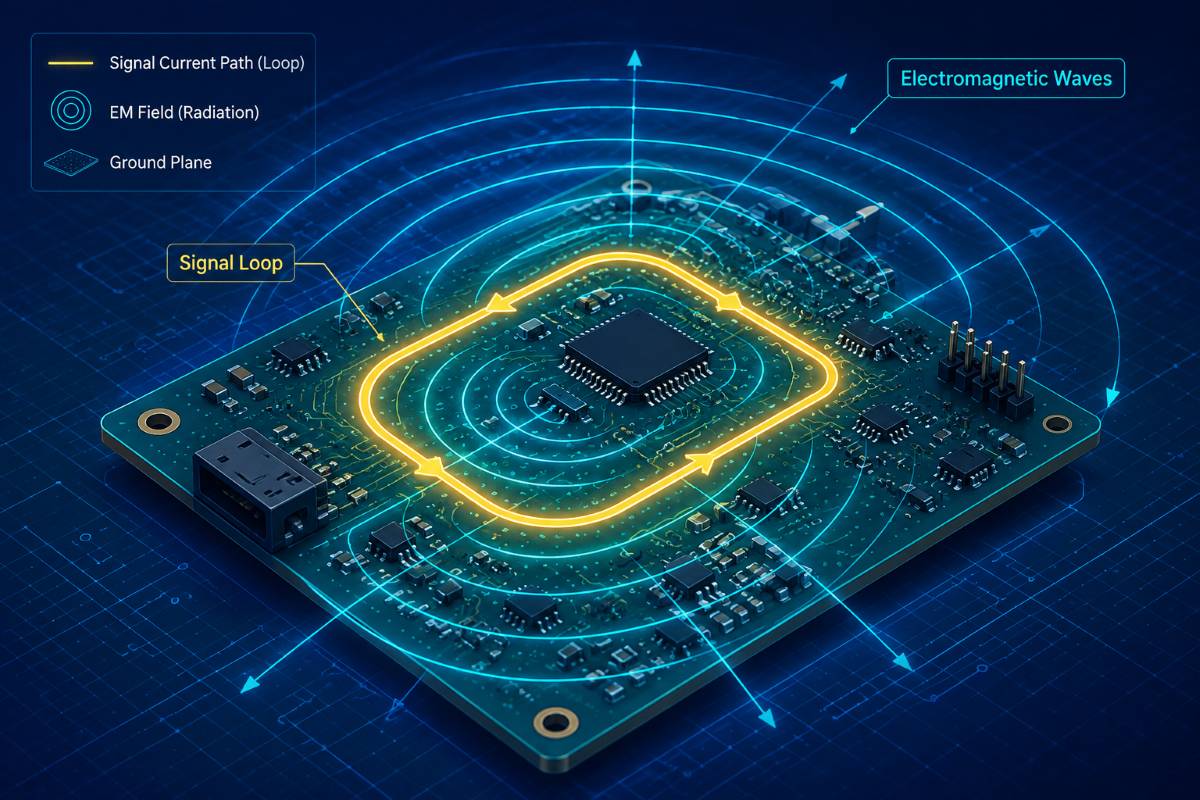
“Why does a board radiate noise?”
When you investigate a circuit that failed an EMC test, most of the problems trace back to “wiring that forms a loop.” In this article we explain how an electric circuit works as an antenna and why loop area is directly tied to noise radiation.
Antenna Basics — Two Types of Antenna
There are broadly two types of antenna.
Rod antenna (linear antenna): a straight conductor. Its radiation strength is proportional to “antenna length × current.” In the near field the electric field dominates.
Loop antenna: a loop-shaped conductor. Its radiation strength is proportional to “loop area × current.” In the near field the magnetic field dominates.
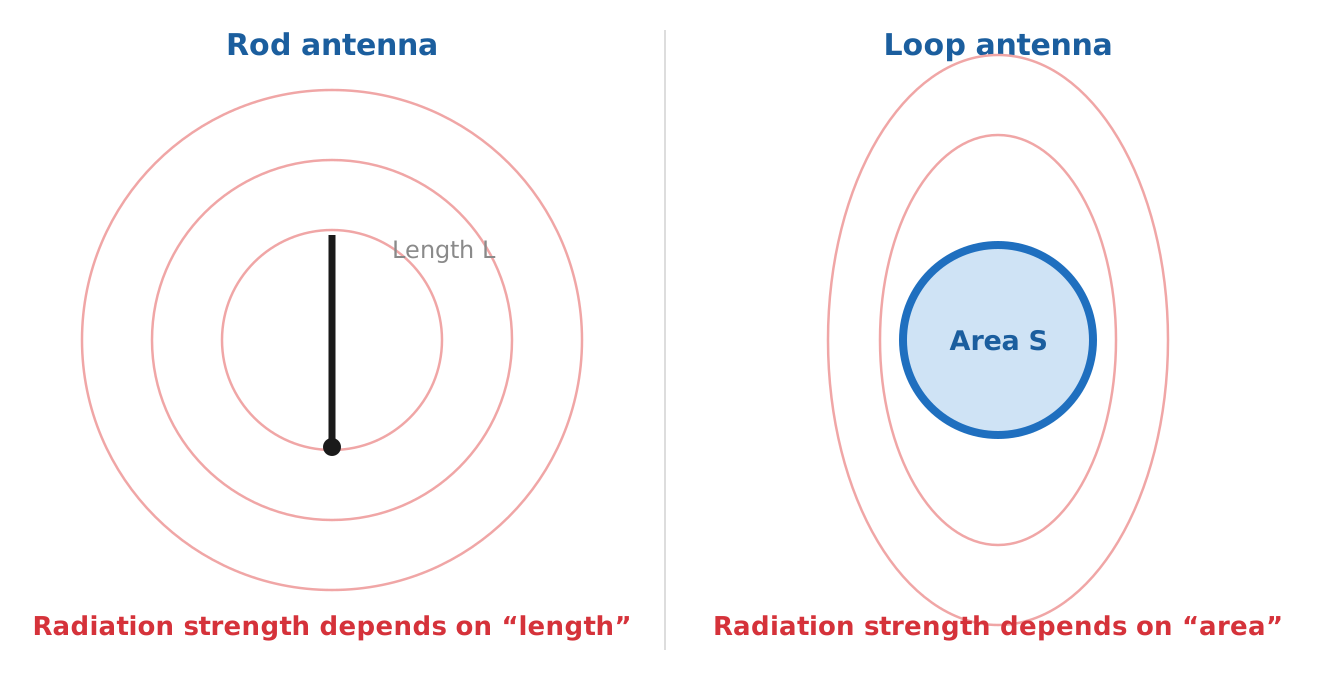
And the wiring on a board unintentionally works as both of these antennas.
The “Hidden Loop” of Signal Wiring
This is the most important point.
A signal trace on a board looks at first like a “short straight line.” But a signal always forms a loop of outbound and return paths. The return path is the shared GND trace. The signal trace plus the GND trace form a loop, and that loop area determines the radiation strength.
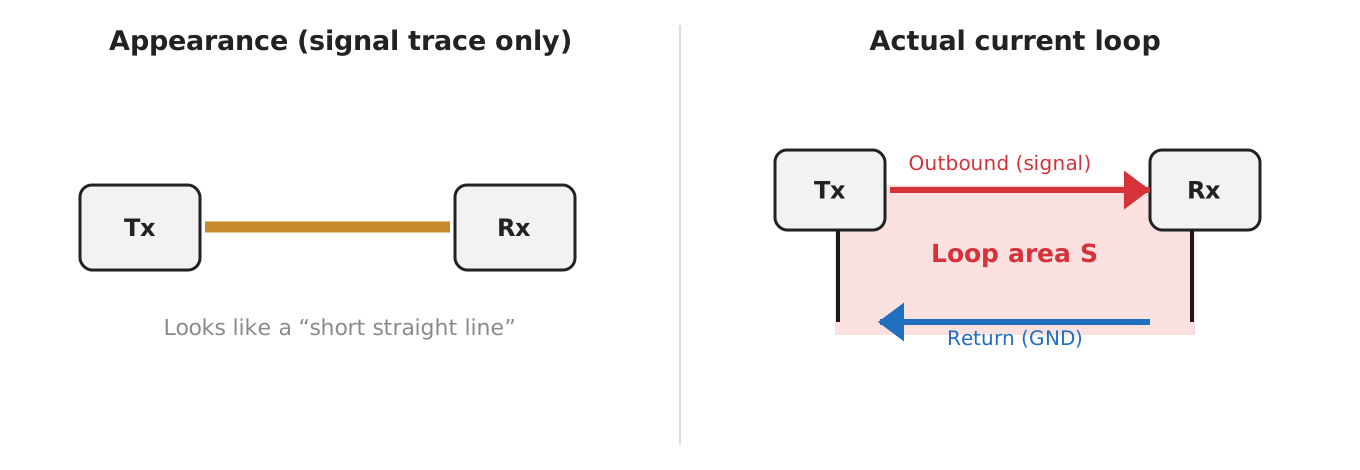
Organized as a formula, the radiation strength of a loop antenna is:
Radiated E-field strength ∝ loop area (S) × current (I) × frequency² (f²)In other words, the larger the loop, the greater the current, and the higher the frequency, the more noise radiation increases. The reason EMC problems get more serious as a digital circuit’s clock frequency rises is that radiation grows with the square of frequency.
Minimizing Loop Area Is the Basic Countermeasure
The most direct way to suppress radiation is to make the loop area small.
Countermeasure 1: Bring the Signal Trace and GND Closer
Place a GND plane directly beneath the signal trace and the GND current flows right under the trace, minimizing the loop area. This is one of the main reasons for providing a GND plane in a multilayer board.
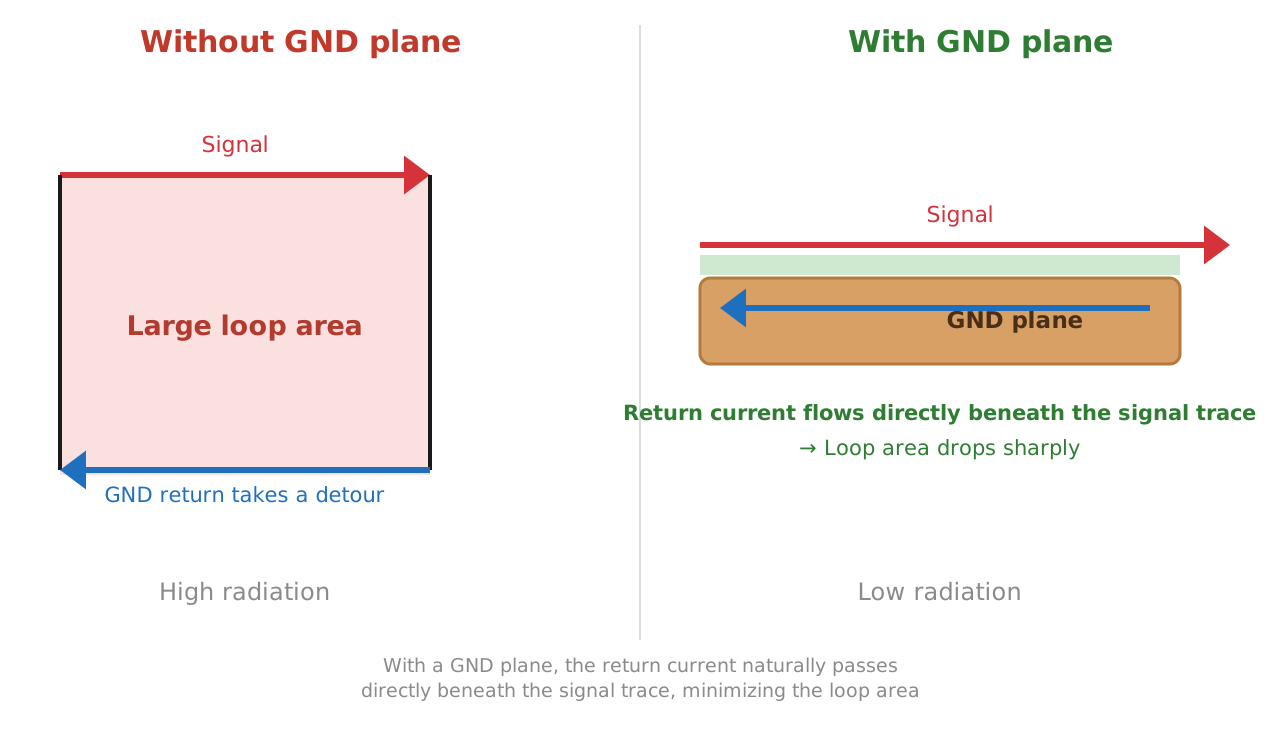
Countermeasure 2: Route with the Return Path in Mind
On a 2-layer board without a GND plane, it is important to be aware of where the GND current flows. Running a GND trace alongside the signal trace makes the loop smaller.
Countermeasure 3: Localize the Loop with a Decoupling Capacitor
Abrupt changes in an IC’s supply current are a major cause of loop radiation. By placing a decoupling capacitor right next to the IC, you can localize the loop carrying the large current to a small region around the IC.
Rod-Antenna Effect — Radiation from External Cables
If the loop-antenna effect is a problem inside the board, the rod-antenna effect is mainly a problem of external cables.
A cable leaving an electronic device is a long, straight conductor. The signal current inside the cable (normal mode) cancels on its outbound and return paths, so it does not radiate. But common-mode current flows in the same direction, so no cancellation occurs, and it radiates noise strongly as a long rod antenna.
Switching power supplies are a typical source of common-mode noise. When common-mode noise inside the board rides onto an external cable, that cable becomes a giant antenna. Conversely, it also picks up strong external noise as common mode through the cable.
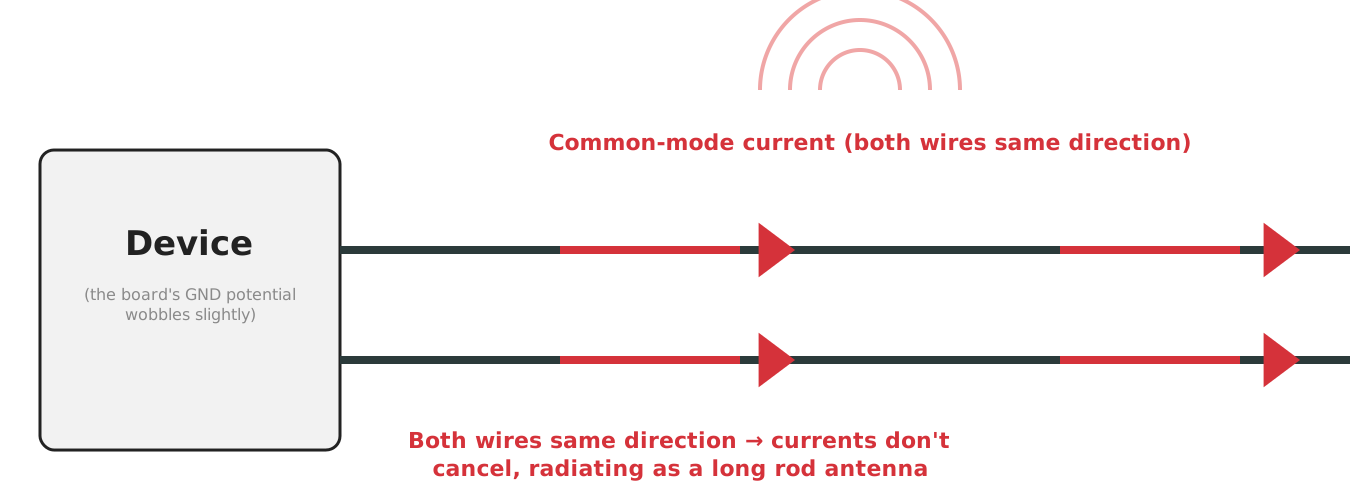
This is why a common-mode filter (CMC) is placed at the cable exit. By cutting the common-mode component before it gets onto the cable, you prevent the cable from becoming an antenna.
Loops Also Increase Inductance
The downside of a large loop area is not only radiation. Loop-shaped wiring has inductance. The larger the loop, the more inductance increases, and the more the noise voltage from V = L × di/dt increases too.
In other words, “making the loop area small” is a two-birds-with-one-stone measure that works for both reducing radiated noise and reducing ground bounce.
Summary
- Wiring unintentionally works as an antenna. Loop-shaped wiring is a loop antenna; straight wiring is a rod antenna.
- A loop antenna’s radiation strength is proportional to “loop area × current × frequency².”
- The real radiation source is the loop including the GND current that returns the signal. Return it directly underneath with a GND plane to minimize the loop area.
- External cables become powerful rod antennas for common-mode current → cut it with a CMC.
- Reducing loop area achieves both radiation reduction and inductance reduction at once.

Comment