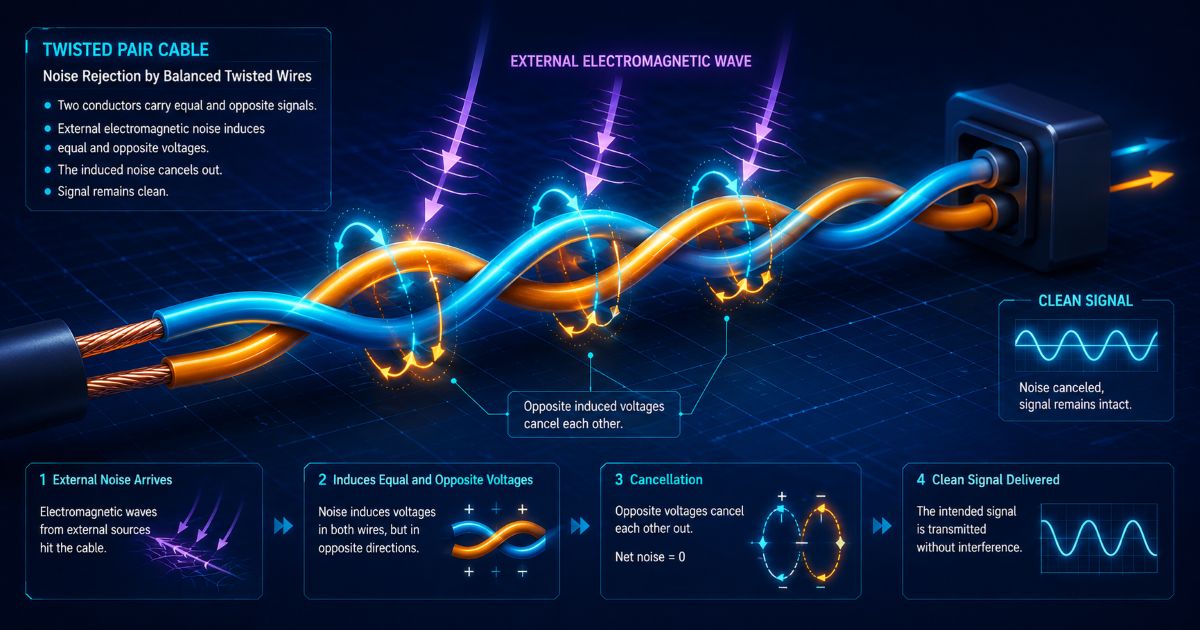
LAN cables and audio cables use a “twisted pair” construction. Surprisingly few people have an intuitive grasp of why twisting two wires together makes them resistant to noise.
This article starts from the idea of balance and explains how a twisted-pair cable cancels noise.
What “Balanced” Actually Means
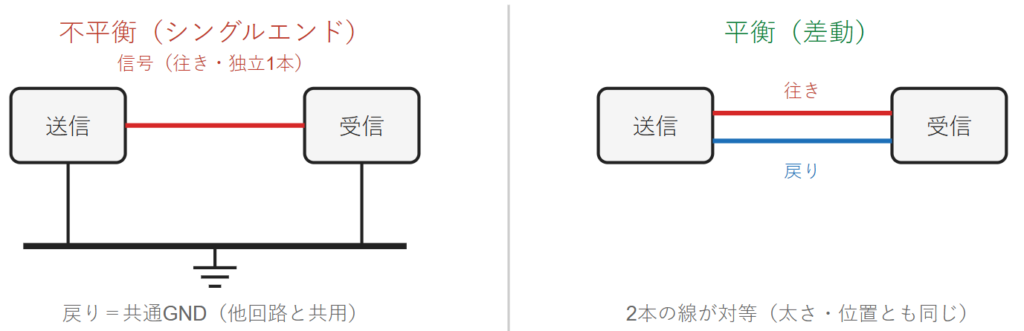
In an electrical circuit, balance means that the outgoing and return conductors of a signal are equivalent in every respect.
An ordinary signal line (single-ended) has one dedicated outgoing conductor, but its return path is a shared conductor called ground. The outgoing and return paths are asymmetric, so this is unbalanced.
A configuration in which the outgoing and return paths are perfectly equivalent is called a balanced circuit. Perfect balance is impossible in practice, but “equivalent enough for practical purposes” still counts as balanced.
What Balance Buys You — External Noise Arrives as Common Mode
The greatest benefit of balanced wiring is that noise from outside enters as common mode.
When the two conductors run side by side as equals, external electromagnetic noise induces the same amount of voltage on both. That is common mode. No differential (normal-mode) component appears.
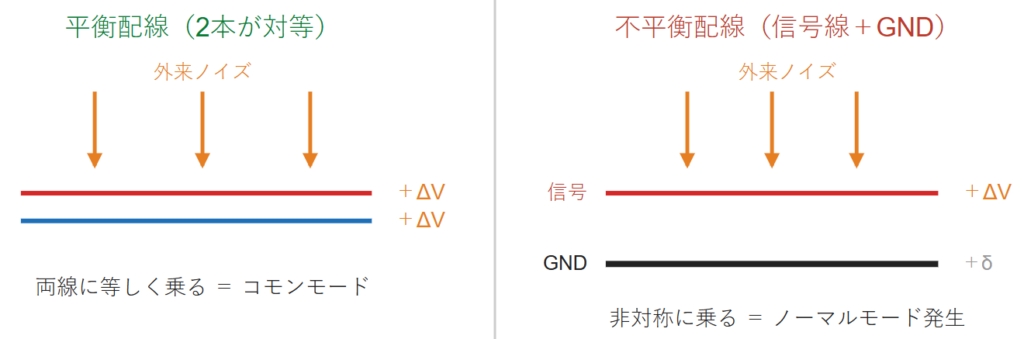
Common-mode noise can be removed by exploiting the difference between the modes (see the article on common-mode noise). Normal-mode noise shares the same mode as the signal, so it is difficult to remove.
In other words, the strategy behind balancing is to accept common-mode noise in exchange for rejecting normal-mode noise. Whatever is picked up can still be removed as long as it is common mode, so the link ends up more robust overall.
Why a Twisted Pair Works
Among balanced cables, the highest degree of balance you can achieve in practice is the twisted-pair cable — two conductors twisted around each other in a helix.
When It Picks Up External Noise
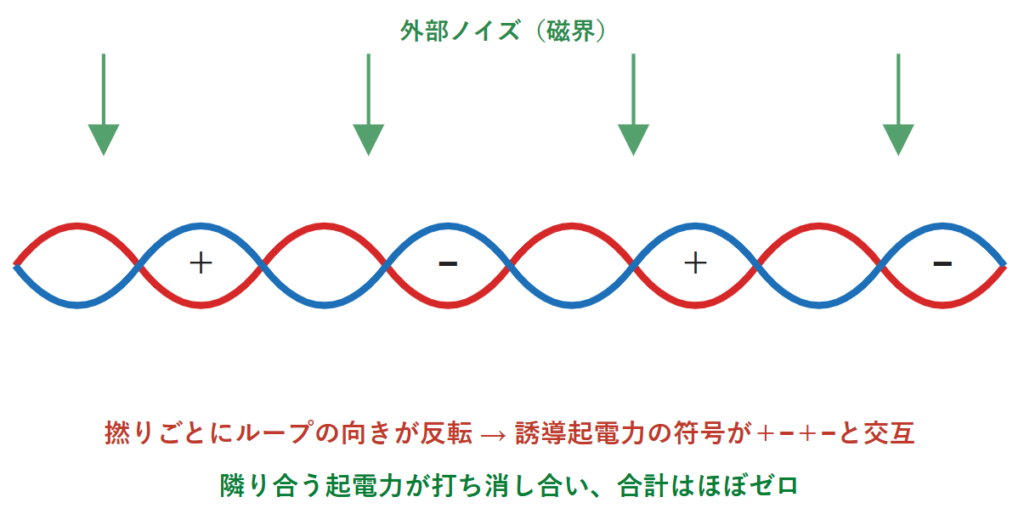
When external magnetic flux (a changing magnetic field) links the cable, an electromotive force appears in the loop — electromagnetic induction. In a twisted pair, the orientation of the loop the flux passes through reverses from one twist to the next.
As a result, the EMFs generated in successive twists cancel one another, and the overall noise voltage approaches zero.
When It Emits Noise
Current flowing in the cable generates magnetic flux, but in a twisted pair the current direction reverses between adjacent twists. The flux cancels as well, so leakage away from the cable becomes very small.
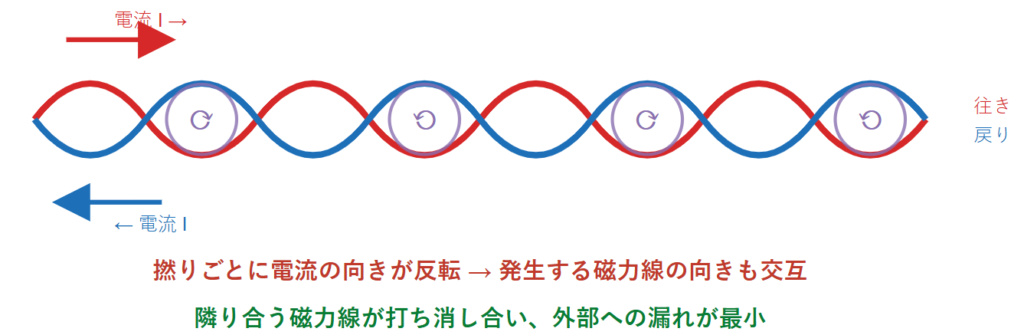
A twisted pair is therefore good on both counts: it neither picks up noise easily nor emits it easily.
How It Differs From a Parallel Cable
A “parallel cable,” with two untwisted conductors running side by side, also has a certain degree of balance. But because the two conductors stay in the same relative positions along the whole run, the direction of an external field can put far more noise on one conductor than on the other.
Twisting makes the average position of the two conductors coincide, so the cancellation works against noise arriving from any direction.
Balanced Wiring on a PCB
On a printed circuit board you cannot build true balanced wiring equivalent to a twisted pair. You can, however, route the outgoing and return traces alongside each other and obtain a degree of balance comparable to a parallel cable.
A signal trace combined with a ground plane (a microstrip line) also behaves much like a coaxial cable at high frequencies, and shields against external noise.
When Balance Is Needed — and When It Is Not
A balanced circuit needs more conductors and costs more. Not every connection has to be balanced.
Where balance is particularly effective:
- Long-distance transmission and interfaces between equipment (RS-422, RS-485, Ethernet and so on)
- Low-level signals and sensor outputs, where the common-mode voltage is large
- Signal transmission in a high-noise environment
Digital circuits inside a product have noise margin, so unbalanced (single-ended) wiring is normally sufficient. Making only the interface section differential is the realistic design choice.
Summary
- Balance means outgoing and return conductors that are equivalent. External noise arrives as common mode, and normal-mode noise is suppressed
- The twist structure cancels the EMF induced by external noise — the highest degree of balance achievable in practice
- It is not only hard to disturb, it also leaks little noise outward — good as both victim and aggressor
- Effective for long-distance transmission and low-level signals. Single-ended is normally enough inside a product


Comment