
When performing transient analysis in uSimmics (formerly Qucs), you may notice that immediately after a signal transition, the waveform begins to oscillate in a jagged manner. This phenomenon is known as ringing.
When seeing this waveform for the first time, many people suspect that “noise is coupling in” or that “something is wrong with the simulation conditions.” However, ringing is neither accidental nor a simulation artifact. It is a fundamental physical phenomenon that occurs because the circuit behaves exactly as physics dictates.
In this article, we intentionally generate a minimal circuit that produces only ringing using uSimmics, and clarify its nature by observing the resulting waveforms.
- How to Think About Ringing in uSimmics
- Ringing Is Often the First Physical Phenomenon Designers Encounter
- The Root Cause of Ringing: Resonance Between L and C
- Reproducibility of Ringing in uSimmics
- Observing Only Ringing with a Minimal Circuit
- Circuit Parameters (Common Conditions)
- Case 1: R = 1 Ω (Reference)
- Case 2: R = 5 Ω (Intermediate)
- Case 3: R = 10 Ω (Strong Damping)
- What We Learn by Comparing the Three Waveforms
- The Minimal Circuit as a Microcosm of a Real PCB
- Summary: Changing Resistance Changes How Ringing Settles
How to Think About Ringing in uSimmics
When examining ringing in uSimmics, it is important to keep the circuit as simple as possible and avoid introducing unnecessary factors.
- Do not use transmission lines
- Keep the circuit locally concentrated
- Use a configuration dominated by L and C
By following these points, the jagged oscillations immediately after the signal transition can be clearly identified as ringing caused by LC resonance.
Ringing Is Often the First Physical Phenomenon Designers Encounter
Ringing is one of the first physical phenomena that many designers encounter when working with high-speed signals. Simply rerouting a trace slightly, or switching to a faster IC, can suddenly reveal oscillations that were not visible before.
What is happening here is neither a design mistake nor a quirk of the simulation tool. It is simply that inductance (L) and capacitance (C), which could previously be ignored, can no longer be neglected.
The Root Cause of Ringing: Resonance Between L and C
The cause of ringing lies in the inductance (L) and capacitance (C) present in the circuit. Even if no explicit components are added, traces, vias, and current loops inherently act as inductance, while IC input capacitance and parasitic capacitance always exist.
At the moment a signal rises, energy is rapidly injected into the circuit. This causes energy to oscillate back and forth between L and C. This oscillation is resonance, and it is the source of the jagged waveform observed in uSimmics.
Reproducibility of Ringing in uSimmics
When observing ringing in uSimmics, you will notice that the oscillation appears with nearly the same period and shape every time. This is because ringing is not random noise, but a phenomenon determined by the circuit configuration.
As long as L and C remain fixed, repeated simulations produce nearly identical results. This reproducibility demonstrates that ringing is a phenomenon that can be understood and controlled through design.
Observing Only Ringing with a Minimal Circuit
To properly understand ringing, the most effective approach is to build a minimal circuit in which ringing is the dominant behavior, without mixing in other effects such as reflection.
Here, we keep the circuit structure fixed and compare waveforms while changing only the resistance R. This allows us to clearly observe how ringing appears and how it settles.
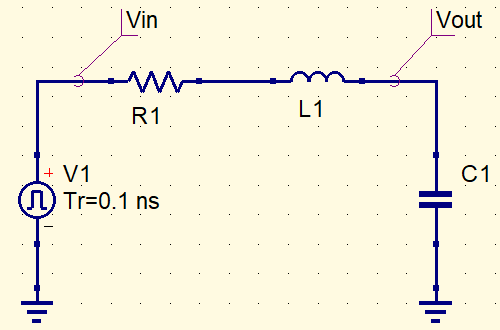
Minimal circuit for observing ringing
VPulse ─ R ─ L ──●── Vout
                  |
                  C
                  |
                 GND
The observation point is Vout (the upper terminal of capacitor C). At this node, ringing immediately after the signal transition is most clearly visible.
Circuit Parameters (Common Conditions)
The following conditions are common to all cases. L and C are fixed, and only the resistance R is varied to observe differences in ringing behavior.
- VPulse: 0 → 1 V, Tr = 0.1 ns, Tf = 0.1 ns
- L: 10 nH (representing trace and loop inductance)
- C: 10 pF (representing IC input capacitance)
- R: 1 Ω (reference) → 5 Ω → 10 Ω (comparison)
With L = 10 nH and C = 10 pF, the ringing period is approximately 2 ns.
Case 1: R = 1 Ω (Reference)
First, we examine the waveform with R = 1 Ω to observe the basic characteristics of ringing. Because R is small, damping is weak, and the ringing persists clearly for a long time.
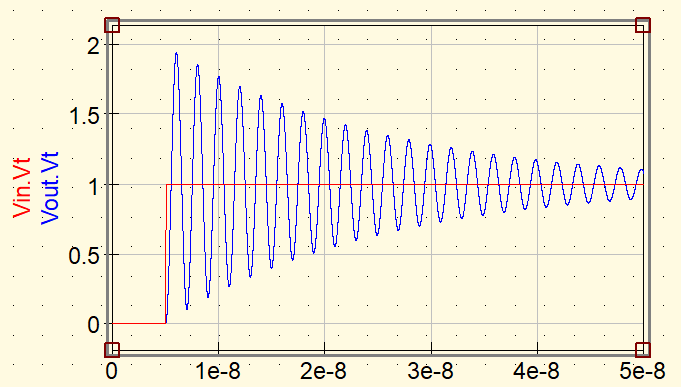
- Large amplitude
- Oscillation takes a long time to settle
- Period is approximately 2 ns
Case 2: R = 5 Ω (Intermediate)
Next is the waveform for R = 5 Ω. Increasing R reduces the amplitude of ringing and causes it to settle more quickly.
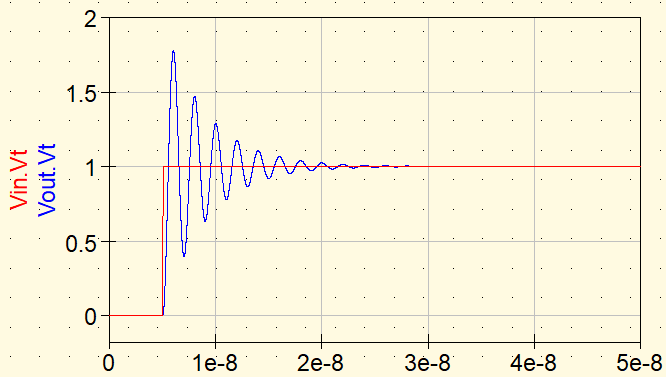
- Period remains nearly the same
- Number of oscillation cycles decreases
- Jagged waveform after the transition becomes less noticeable
By comparing these waveforms, it becomes intuitively clear that changing R does not affect the period.
Case 3: R = 10 Ω (Strong Damping)
Finally, consider the waveform for R = 10 Ω. With further increased resistance, ringing settles in a very short time. In some cases, it may become almost invisible.
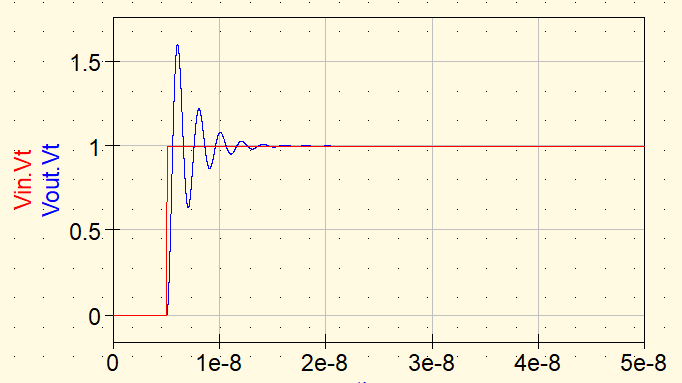
- Period remains unchanged
- Amplitude is small and quickly settles
- Not “gone,” but strongly damped and harder to see
What We Learn by Comparing the Three Waveforms
Comparing the three waveforms makes the following points clear:
- The ringing period is determined by L and C
- Resistance R changes only the damping strength without affecting the period
- Resistance does not “stop” resonance, but dissipates energy and allows it to settle
Once this comparison is understood, it becomes clear why series resistors and damping resistors are effective—without needing to rely on equations.
The Minimal Circuit as a Microcosm of a Real PCB
Although this circuit is extremely simple, its underlying behavior is the same as what occurs on real printed circuit boards.
- Longer traces
- Larger current loops
- Increased IC input capacitance
All of these effects act to increase L and C in the circuit. The minimal circuit built in uSimmics is simply an easy-to-observe extraction of the ringing phenomena that occur on real boards.
Summary: Changing Resistance Changes How Ringing Settles
- Ringing is oscillation caused by LC resonance
- It appears immediately after signal transitions
- The period is determined by L and C
- Resistance R is effective in damping the oscillation
By comparing waveforms with different values of R, it becomes clear that ringing is not “mysterious noise,” but a phenomenon that can be understood and controlled through design.
After you can “see” what ringing really is, the next step is the ferrite bead. You’ll learn how to judge why it works / and why it sometimes doesn’t by looking at waveforms.
▶ Next: Why Ferrite Beads Work: Understand the Real Reason Through Waveforms


Comment