Noise Design & EMC

What Is Common-Mode Noise? Difference from Normal Mode, with Filter Circuits

Common-mode vs normal mode — what's the difference, and why is common mode easy to remove? Learn the definitions (EN = EA−EB, EC = (EA+EB)/2), how a common-mode choke and differential receiver reject it, explained with filter circuits.
Noise Design & EMC

Why Traces Become Antennas: Loop Area and Noise Radiation

Why does a PCB radiate noise? The hidden loop formed by a signal trace and its GND return sets the radiation. Learn why radiation ∝ loop area × current × frequency², and how a ground plane minimizes the loop.
Noise Design & EMC

Single-Point Ground vs. Ground Plane: Which Is Right? (uSimmics)

Single-point ground or a ground plane? Both are correct — but which you use depends on frequency. Learn how common impedance and stray capacitance decide it, compared in uSimmics, plus mixed analog/digital board tips.
Noise Design & EMC

Why Are Decoupling Capacitors Placed Close to the IC? (uSimmics)

Why must a decoupling capacitor sit close to the IC? Learn how wiring inductance (L_wire) and the capacitor's ESL kill high-frequency performance, verified with uSimmics waveforms, plus two-stage placement and layout tips.
Noise Design & EMC

What Is Ground Bounce? Why GND Isn’t 0V, Explained with uSimmics

GND is supposed to be 0V — so why does noise appear? Learn how wiring inductance and V = L×di/dt cause ground bounce, verified with uSimmics simulations, plus three fixes: decoupling caps, a solid ground plane, and reducing di/dt.
Basics

What Is Qucs-S? Differences from LTspice and uSimmics Explained [2026 Edition]

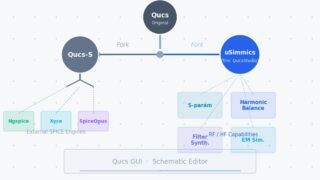
Qucs-S is an open-source circuit simulator that connects the Qucs interface to SPICE engines. This article explains what Qucs-S is, how it differs from LTspice and uSimmics, and when it is useful.
Basics

What Is uSimmics? Why QucsStudio Changed Its Name and What Has Changed [2026 Edition]

uSimmics, formerly QucsStudio, is a free and powerful circuit simulator. This article explains why QucsStudio changed its name, what has changed, compatibility with old files, and its position among the Qucs family.
Basics

LTspice vs. uSimmics (formerly QucsStudio): Which Should You Use? [2026]

LTspiceとuSimmics(旧QucsStudio)の違いを機能・エンジン・用途で徹底比較。高周波RF設計ならuSimmics、アナログ電源設計ならLTspiceという使い分けの根拠を2026年版で解説します。
Noise Design & EMC

What Is Crosstalk? Understanding Parasitic Coupling in PCB Traces

Crosstalk is an unavoidable effect in high-speed PCB design. This article explains crosstalk at the circuit level, focusing on parasitic capacitive and inductive coupling that do not appear in schematics.
Noise Design & EMC

Why Ferrite Beads Work: Damping Ringing with Loss (uSimmics Waveforms)

Learn why ferrite beads reduce ringing: it’s loss, not “inductance.” Compare ideal L, ideal R, and a real bead (.s2p) in uSimmics.